From oracle bones to smartphone keyboards, Chinese has a 3,000-year paper trail. Here is what every learner should know about how it got to where it is today.
The language you are studying right now is one of the oldest continuously used writing systems on the planet. That is not a throwaway fact; it genuinely changes how you should think about learning it. When you write a character today, you are often tracing a shape that a scribe carved into bone three millennia ago. Understanding where Chinese came from makes the vocabulary, the characters, and even the grammar feel far less arbitrary.
The oracle bones: where it all started
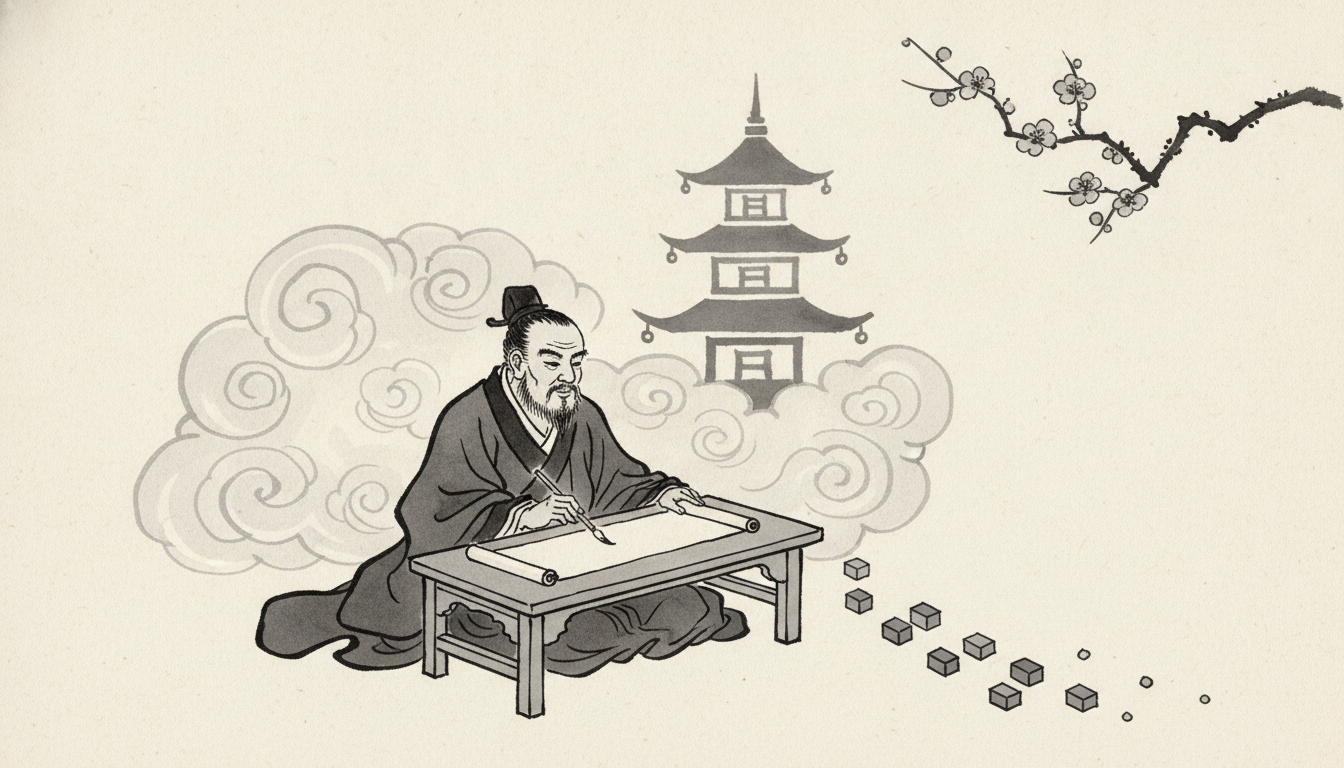
The earliest confirmed Chinese writing dates to around 1200 BCE, during the Shang dynasty. Priests would scratch questions onto turtle shells and ox shoulder blades, heat them until they cracked, and then read the cracks as divine answers. These inscriptions are called jiǎgǔwén (甲骨文), literally "shell-bone writing." Archaeologists first discovered them in the late 1800s near Anyang, in modern Henan province.
What is remarkable is how many of those ancient pictographs survived, in evolved form, into the characters you use today. The character for (rì, "sun") started as a simple circle with a dot in the center, a direct sketch of the sun. (yuè, "moon") was drawn as a crescent. You can still see those shapes if you look closely. This is not myth; it is documented visual continuity across three thousand years.
By the Zhou dynasty (1046-256 BCE), writing had spread beyond ritual use into record-keeping, poetry, and philosophy. The texts of Confucius and Laozi were composed in what scholars call Classical Chinese, a highly compressed written language that stayed the literary standard for over two thousand years, long after spoken Chinese had drifted far away from it.
How characters evolved through the dynasties
Writing systems rarely stay still, and Chinese is no exception. After the Zhou came a chaotic period of competing states, each with its own regional script. When the Qin dynasty unified China in 221 BCE, the emperor Qin Shi Huang standardized the writing system into a script called Small Seal Script (xiǎozhuàn, 小篆). This was a deliberate top-down reform, enforced across a vast empire, and it set a precedent: the Chinese state would periodically reshape its own script when it served political goals.
The next major shift was practical rather than political. Clerks needed to write faster, so Seal Script gradually smoothed out into a squarer, more angular form called Clerical Script (lìshū, 隸書). From there, the running hand (xíngshū) and cursive script (cǎoshū) developed for everyday writing, while Regular Script (kǎishū, 楷書) became the formal printed standard. The kǎishū you see in textbooks today is essentially that same Regular Script, settled in the Tang dynasty (618-907 CE) and barely changed since.
One word worth pausing on here is 书shū (shū), which means both "writing" and "book." Its traditional form, 書, shows a brush (聿) over a mouth (曰), capturing the idea of recording what is spoken. The simplified form collapsed some of those strokes, but the core radical is still there if you know where to look.
The spoken language: one country, many tongues
Here is something that surprises many learners: "Chinese" is not one spoken language. It is a family of languages, including Cantonese, Hokkien, Shanghainese, and dozens of others, that share a writing system but are mutually unintelligible when spoken. A speaker from Guangzhou and a speaker from Beijing could read the same newspaper but not understand each other in conversation.
The variety you are almost certainly learning is Mandarin, known in Chinese as 普通话pǔtōnghuà (pǔtōnghuà), meaning "common speech." Putonghua is based on the northern dialects centered around Beijing, and it was promoted as the national standard language throughout the 20th century. The People's Republic of China made it the official language after 1949, teaching it in schools across every province and region. The effort worked, at least for formal contexts, today the vast majority of people in mainland China can speak Pǔtōnghuà with HSK 1 vocabularypractice HSK 1 vocabulary and basics, even if a regional dialect is still used at home. Taiwan calls its standard form Guóyǔ (國語), "national language," and uses the same phonological base. Internationally, the term "Mandarin" has become the default label in English.
The 20th-century simplification reform
The most controversial chapter in modern Chinese linguistic history is the simplification of characters. In the early 20th century, China was grappling with very low literacy rates. Many reformers argued that the complexity of traditional characters was itself a barrier, and that reducing stroke counts would make reading and writing accessible to more people.
The government of the People's Republic of China rolled out Simplified Chinese (简化字, jiǎnhuàzì) in two main waves, in 1956 and 1964. Some simplifications followed historical shorthand forms that had existed for centuries. Others were more radical, merging distinct characters or replacing components wholesale. The character 学xué (xué, "to learn/study"), for example, dropped from 16 strokes in its traditional form 學 to 8 strokes, with handwriting tools helping modern learners master both forms. The change is significant but the top component, representing two hands passing something down, is still visible.
Taiwan, Hong Kong, and most overseas Chinese communities continued using Traditional characters. This split is still live today. If you are learning for travel in mainland China, business with the PRC, or consuming mainland media, Simplified is the practical choice. If your focus is Taiwan, classical texts, or Cantonese media, Traditional is worth the investment. Neither is more "correct"; they are two branches of the same tree.
Pinyin and the question of romanization
Before the People's Republic settled on Pīnyīn (拼音) in 1958, there were multiple competing systems for writing Chinese sounds in the Latin alphabet. The most widely used before Pinyin was Wade-Giles, invented by British diplomats in the 19th century. That is why older books write Mao Tse-tung instead of Máo Zédōng, or Peking instead of Běijīng.
Pinyin is now the global standard. It is the system used on the UN, on signage across China, and, crucially, on every smartphone input method in mainland China. When a user types on a Chinese phone, they type Pinyin and the phone converts it to characters. In that sense, Pinyin is not just a learning tool; it is the backbone of how hundreds of millions of people type every single day.
For you as a learner, the most important thing to know is that Pinyin is phonetic but not intuitive for English speakers, which is why hanzi to pinyin practice is essential. The letter "x" sounds like "sh", "q" sounds like "ch", and "zh" is closer to "j." Spending real time with 发音fāyīn (fāyīn, "pronunciation") early on will save you enormous confusion later. The tones are part of the phonology too; 妈mā (mā), 马mǎ (mǎ), and 骂mà (mà) are three completely different words written with the same letters.
The takeaway
Chinese has been reinventing itself for three thousand years, through unification wars, dynastic collapses, literacy campaigns, and digital revolutions, and it is still recognizably itself. The character you write for "sun" today carries a visual memory of a Shang dynasty sketch. The standard you speak was a deliberate 20th-century construction that now has over a billion users. None of this makes Chinese harder to learn; if anything, it gives you context for why things are the way they are. A language with this much history behind every stroke is worth the effort.
Master HSK 3 vocabulary efficiently using focused categories and daily review. Learn the best words to study first and build a realistic study plan for success.
Master the essential 150 HSK 1 words and start speaking Chinese confidently. Learn the most common everyday vocabulary that forms the foundation of beginner Chinese.
·
Confused about the HSK exam system? This guide breaks down every level from HSK 1 to HSK 6, explaining what vocabulary and skills each one covers, how they compare to other language frameworks, and how to use them as a roadmap for your Chinese learning journey.